My quest to find out more about Lt G D Carroll’s service during the blitz on Malta, and put his name in its rightful place in history, was well underway. But among the wealth of World War 2 records, I had discovered there were three other Bomb Disposal Officers who served after him, whose names did not appear on any ‘list’ either (see 2 March). I decided that each of them deserved recognition for their part in keeping the Island’s people free from the danger of UXBs.
And if my book was going to be more than a daily log, I had to know something about them, and what stories they might have to tell. I needed to trace these officers – or their families, if sadly they were no longer around.
I had three signatures on Bomb Disposal Reports: F W Ashall, T Whitworth and H Lavington – and nothing more. I’d learned very quickly that no personnel records for World War 2 are yet in the public domain.
Thanks to my late brother Chris I had an alternative. He’d asked me to carry on his research into our family history. I’d accepted willingly, not realising at the time that he left me a way to connect with three important characters in UXB Malta.
So where to start? I had no full Christian names, although at least the surnames were not too commonplace. I didn’t know which part of England they were from. I could only estimate their age range from the other BD Officers, Malta: Lt E E C Talbot was 21, Lt G D Carroll was 23 and Lt T W T Blackwell 34.
I turned to the Ancestry website to search for their births by surname. I struck lucky with Ashall: Frederick W came up, born in Lancashire – and he was married there. A search of Ancestry’s British Phone Books suggested he returned to Lancashire after the war. I went to BT Enquiries: there was no F W Ashall but there was a possible entry for his wife. I picked up the phone, and a few weeks later I was sitting with Mrs Ashall and her son, listening to stories of Frederick’s time in bomb disposal.
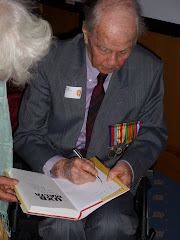
There were two Henry Lavingtons, both born in Hampshire. One trail went cold in London, the second had a surprise in store. According to Ancestry, from the 1950s one Henry Lavington had lived in Gillingham, Kent – barely three miles from George Carroll. I could scarcely believe it when a cheerful Henry himself answered my telephone call. I was privileged to meet him several times, before he sadly passed away last year.
There were 48 T Whitworths (Thomas, Trevor, Terence etc). I’d almost given up hope of finding the right one, when I visited Henry for the first time. He worked alongside Whitworth, and was fairly sure he came from Lancashire, so I posted a ‘seeking old comrades’ notice in the local paper. No response. By this time I had narrowed the field to about 6 candidates, their spouses and children, whose birth places might give me a clue to their whereabouts. I called a few possible descendants, with no success.
When I hit a brick wall like this in research, I often ease my frustration by putting the elusive item into a Google search, to see what comes up. This time I found Thomas Whitworth, Master of Hatfield College, and there was the text “During World War II, Whitworth served with the Royal Engineers (Bomb Disposal) in North Africa…”. It had to be the same man. Sadly he died in 1979 but his wife was named, and with that I could trace his family.
I only wish I could have tracked down all those who served in RE Bomb Disposal in Malta. Other routes such as Genes Reunited can be useful but it’s a matter of chance to find a relative close enough to know about their wartime service.
But Chris unknowingly left me one more gift. Going through his papers one day, I found an email from someone responding to one of his searches for our great-grandfather’s birth in Malta. She wrote that her grandfather, Harry Turner, had served in RE Bomb Disposal there during the war. I was on my way to meet another family…
Showing posts with label "bomb disposal" "Malta" "World War 2" "military history". Show all posts
Showing posts with label "bomb disposal" "Malta" "World War 2" "military history". Show all posts
Tuesday, 6 April 2010


Friday, 19 March 2010
UXB Malta: making history
A whole year on from my first attempt to find the records of Royal Engineers Bomb Disposal in Malta, I finally held in my hands the relevant War Diary. In my elation, I could never have envisaged the task ahead of me.
A War Diary is a daily log of the main events of each relevant unit. The Diary of the Fortress Engineers, Malta, describes work done by the various subsidiary Companies, as well as air raids, casualties and damage to their headquarters. The Bomb Disposal (BD) Report for each week was attached as an appendix to the War Diary.
The first document I saw with the signature of 'Lt Geo D Carroll' as Bomb Disposal Officer was the BD Report for the week ending 10 May 1941. It listed the 59 unexploded bombs dealt with that week, with details for each one: serial number and date of the UXB report, the location, nationality, size and type of bomb (eg 50kg SD), whether it was on the surface or how deep it was buried. The final column logged the date the bomb was rendered harmless, with a brief description of the action taken.
It was only then that the enormity of what I'd uncovered began to sink in. As I read page after page describing what had actually gone on compared to what I’d found in books, I realised that the ‘booklet’ I'd planned to write couldn't possibly do the story justice. I began to contemplate writing my first book.
I had unearthed a goldmine: detailed, day to day account of the actions of RE Bomb Disposal in Malta from 1940 to 1944, and of the environment they worked in. More than a thousand pages of information revealed endless air raids, and the resulting thousands of unexploded bombs that were dealt with. Thanks to the National Archives, I was allowed to take copies of the documents, so I could study them at home between return visits to collect more.
But now I had to work out what all this information could tell me; statistics and lists are meaningless without interpretation. I was used to handling research material in some detail but this was on a different scale altogether. I had to develop new skills and devote hours to collating it all. I began to wonder what kind of person I might have to become, in order to create this history! For once, the amount of rest demanded by my illness (see earlier blog) worked in my favour. I spent weeks transcribing the documents into MS Excel, so I could analyse the data. That way I could take an overview of any aspect, according to the story I had to tell or a question I needed to answer.
Locations were an interesting challenge: many of the UXB records carried a map reference instead of a place-name. Without access to the relevant military map, I worked out a grid from the references I had and drew it onto my own Malta map, so I could locate the bombs. The activity reminded me of a skeleton crossword puzzle. When I did eventually find a copy of the real map, I wasn’t far off. Now I could plot the reported UXBs, link them to actual air raids and understand the implications for their surroundings. With map in hand, I set off to Malta to ‘walk the course’.
As I write this, even I am beginning to wonder at my own persistence. No wonder it took me three years to get to the first draft. It was worth it. I emerged from the intense activity with a robust body of information from which to construct the book. As well as providing the framework for the story, it meant I could give a much fuller description of the actions logged in the official reports, as well as linking events recounted by former members of REBD Malta with the likely date and location of the UXB concerned.
I wasn’t finished yet. Now that I was writing a book about bomb disposal, I had to learn how it was done.
A War Diary is a daily log of the main events of each relevant unit. The Diary of the Fortress Engineers, Malta, describes work done by the various subsidiary Companies, as well as air raids, casualties and damage to their headquarters. The Bomb Disposal (BD) Report for each week was attached as an appendix to the War Diary.
The first document I saw with the signature of 'Lt Geo D Carroll' as Bomb Disposal Officer was the BD Report for the week ending 10 May 1941. It listed the 59 unexploded bombs dealt with that week, with details for each one: serial number and date of the UXB report, the location, nationality, size and type of bomb (eg 50kg SD), whether it was on the surface or how deep it was buried. The final column logged the date the bomb was rendered harmless, with a brief description of the action taken.
It was only then that the enormity of what I'd uncovered began to sink in. As I read page after page describing what had actually gone on compared to what I’d found in books, I realised that the ‘booklet’ I'd planned to write couldn't possibly do the story justice. I began to contemplate writing my first book.
I had unearthed a goldmine: detailed, day to day account of the actions of RE Bomb Disposal in Malta from 1940 to 1944, and of the environment they worked in. More than a thousand pages of information revealed endless air raids, and the resulting thousands of unexploded bombs that were dealt with. Thanks to the National Archives, I was allowed to take copies of the documents, so I could study them at home between return visits to collect more.
But now I had to work out what all this information could tell me; statistics and lists are meaningless without interpretation. I was used to handling research material in some detail but this was on a different scale altogether. I had to develop new skills and devote hours to collating it all. I began to wonder what kind of person I might have to become, in order to create this history! For once, the amount of rest demanded by my illness (see earlier blog) worked in my favour. I spent weeks transcribing the documents into MS Excel, so I could analyse the data. That way I could take an overview of any aspect, according to the story I had to tell or a question I needed to answer.
Locations were an interesting challenge: many of the UXB records carried a map reference instead of a place-name. Without access to the relevant military map, I worked out a grid from the references I had and drew it onto my own Malta map, so I could locate the bombs. The activity reminded me of a skeleton crossword puzzle. When I did eventually find a copy of the real map, I wasn’t far off. Now I could plot the reported UXBs, link them to actual air raids and understand the implications for their surroundings. With map in hand, I set off to Malta to ‘walk the course’.
As I write this, even I am beginning to wonder at my own persistence. No wonder it took me three years to get to the first draft. It was worth it. I emerged from the intense activity with a robust body of information from which to construct the book. As well as providing the framework for the story, it meant I could give a much fuller description of the actions logged in the official reports, as well as linking events recounted by former members of REBD Malta with the likely date and location of the UXB concerned.
I wasn’t finished yet. Now that I was writing a book about bomb disposal, I had to learn how it was done.
Subscribe to:
Posts (Atom)