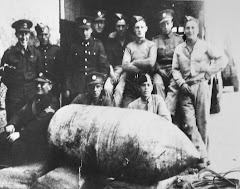
These pages have brought their first reunion between the author and the family of a member of RE Bomb Disposal, Malta, thanks to a comment by Pauline Godwin about her father, L/Sgt Rowland Hilliar, on these pages last year. He never spoke to them about his work in bomb disposal but now the family have read UXB Malta they can be justly proud of his achievements.
It is hoped that other families will do the same, and learn how these men coped in extraordinary circumstances to deal with thousands of unexploded bombs. All of the Royal Engineers Bomb Disposal Officers who served in Malta during World War 2 are named below, taken from official records and War Diaries of 1940-44.
The list of Other Ranks (with Army Service Numbers in brackets, where known) is based only on available secondary information, so it may not be completely accurate.
If you recognise any names, or have any questions, please use the Comments section to get in touch.
Lt Ellis Edward Arthur Chetwynd Talbot (served November 1940 to May 1941)
Lt George Daniel Carroll (served April 1941 to April 1942)
Lt Thomas Walter Townsend Blackwell (served December 1941 to February 1943)
Lt Frederick William Ashall (served April to July 1942)
Lt Thomas Whitworth (served July 1942 to November 1944)
Lt Henry Lavington (served February to October 1943)
OTHER RANKS
Members of 24 Fortress Company, Royal Engineers believed to have served in Malta’s Bomb Disposal Sections during World War 2.
NON-COMMISSIONED OFFICERS
Sgt Holland (102309)
Sgt Reginald Charles Parker (1871236)
Sgt Thomas Piggott (1863676)
L/Sgt Cecil Arthur Brewer (1866450)
L/Sgt George Henry King (1864077)
L/Cpl Rowland Hilliar (1873804)
L/Cpl Cyril Thomas Meager (1872626)
SAPPERS
Spr Joseph Birchenall (1872550)
Spr George Codling
Spr Robert Cushen
Spr Rex Garvin
Spr Thomas Hammond (1872638)
Spr James Lee Leonard (858620)
Spr Lockyer
Spr Duncan MacDonald (1871171)
Spr Daniel McCarthy (1875751)
Spr Laurence Miller (1875725)
Spr Rattenbury
Spr Henry James Reeves (1877565)
Spr C E Reeves (“Inky”)
Spr William Douglas Scott (1871172)
Spr Harry Turner (1875560)
Spr Robert Henry Walter (1873669)
Tuesday, 15 February 2011


Monday, 10 January 2011
UXB Malta is Editor's Choice, Britain at War Magazine December 2010
Britain at War Editor Martin Mace has chosen UXB Malta as his feature of the month in the latest issue of the magazine. Five pages of photographs and extracts from the book highlight the challenges faced by Malta's handful of Royal Engineers Bomb Disposal men during World War Two. Their achievements are set in the context of round-the-clock bombardment by a determined Luftwaffe, who flew over 9,500 sorties against the Island in one month alone as part of a continuous 154 days of air raids (compared to 57 days of the London Blitz.
The article also focuses on the exploits of Lt George Carroll, Bomb Disposal Officer for Malta at the height of the siege, who served continuously through the toughest months of the bombing, working through over 2,000 alerts. Lt Carroll's memories are among the many personal stories collected by the author in what is a remarkable story of human achievement.
Copies of the magazine are available via the website www.britain-at-war-magazine.com or from Britain at War, P) Box 2068, Bushey, Hertfordshire, WD23 3ZF. Email: britainatwar@alliance-media.co.uk.
The article also focuses on the exploits of Lt George Carroll, Bomb Disposal Officer for Malta at the height of the siege, who served continuously through the toughest months of the bombing, working through over 2,000 alerts. Lt Carroll's memories are among the many personal stories collected by the author in what is a remarkable story of human achievement.
Copies of the magazine are available via the website www.britain-at-war-magazine.com or from Britain at War, P) Box 2068, Bushey, Hertfordshire, WD23 3ZF. Email: britainatwar@alliance-media.co.uk.

Wednesday, 21 July 2010
Meet S A M Hudson & BD Veteran George Carroll at War & Peace Show 22-25 July
When the invitation came to appear at the massive War & Peace Show I wasn’t sure how George Carroll would react. But he’d so enjoyed meeting guests at the book’s launch in May, he was definitely up for it.
He’s aiming to be in the Veterans Marquee at the Show on Friday 23 July, from 11.00am, and will stay for as long as he can. George will be signing books and talking to visitors about his experiences in World War 2 – both in Malta and in the London Blitz, which started 70 years ago this August.
I’ll be there too, and happy to sign copies of UXB Malta and talk about how I uncovered the incredible story behind the book. I’ll also be there for book signings on Thursday 22 from 11.00am and Sunday 25 from 12 noon.
I’m looking forward to sharing my experiences with enthusiasts, including a World War 2 bomb disposal re-enactment group.
He’s aiming to be in the Veterans Marquee at the Show on Friday 23 July, from 11.00am, and will stay for as long as he can. George will be signing books and talking to visitors about his experiences in World War 2 – both in Malta and in the London Blitz, which started 70 years ago this August.
I’ll be there too, and happy to sign copies of UXB Malta and talk about how I uncovered the incredible story behind the book. I’ll also be there for book signings on Thursday 22 from 11.00am and Sunday 25 from 12 noon.
I’m looking forward to sharing my experiences with enthusiasts, including a World War 2 bomb disposal re-enactment group.
Tuesday, 1 June 2010
Reviews & Readers' Comments
Here’s what readers are saying about UXB Malta:
“I can thoroughly recommend your book! It’s excellent, well done you have produced a superb reference book that will be often taken off my bookshelf.”
Steve Venus (aka Fuzeman – see www.bombfuzedatabase.com)
“Have finished reading your book - excellent.”
Frederick Galea (Author of Mines over Malta, Call-Out, Women of Malta, Carve Malta on My Heart, (and with Brian Cull) Screwball Beurling, and many more books on Malta in World War 2).
“…half way through your book at the moment and I will be recommending it on our website”
Peter Markham (Royal Engineers Association Bomb Disposal Officers Club)
For a full review of UXB Malta, see http://dalyhistory.wordpress.com/reviews
“I can thoroughly recommend your book! It’s excellent, well done you have produced a superb reference book that will be often taken off my bookshelf.”
Steve Venus (aka Fuzeman – see www.bombfuzedatabase.com)
“Have finished reading your book - excellent.”
Frederick Galea (Author of Mines over Malta, Call-Out, Women of Malta, Carve Malta on My Heart, (and with Brian Cull) Screwball Beurling, and many more books on Malta in World War 2).
“…half way through your book at the moment and I will be recommending it on our website”
Peter Markham (Royal Engineers Association Bomb Disposal Officers Club)
For a full review of UXB Malta, see http://dalyhistory.wordpress.com/reviews
Wednesday, 26 May 2010
Bomb Disposal Survivors Recall 70 Years of Hazardous Service
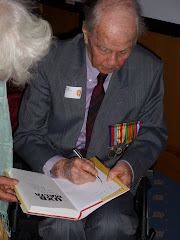
Former bomb disposal officers whose service spans seven decades stood to attention as a roll of honour carrying the names of more than 500 men killed carrying out this dangerous task was played out before them. The act of remembrance was part of a moving presentation commemorating the 70th anniversary of Royal Engineers Bomb Disposal at the RE Museum in Gillingham. The event included the official UK launch of UXB Malta, the history of RE Bomb Disposal on the Island from 1940 to 1944.
The event brought together former wartime Bomb Disposal Officer Lt George Carroll with Major (Retd) Simon Cooke, RE, who recently served in Explosive Ordnance Disposal (EOD) in Bosnia and Afghanistan. Major Cooke compared the challenges of present day EOD operations with the first years of the service during World War 2:
“I think that the principle difference is a shift in focus from dealing with factory made, mass-produced munitions and bombs that have failed to go off [in 1940], to improvised terrorist devices today.” Major Cooke also described the way in which modern technology is used to reduce risk by taking the bomb disposal officer out of direct contact with the bomb, such as sophisticated robots which can attack the bombs themselves but also monitor and sometimes jam signals which could trigger the bomb.
However, he was also keen to point out the similarities between the work of the World War 2 bomb disposal officer and his modern day counterpart, whether in Iraq or Afghanistan – or in the UK. “Who would have thought that the bombs dropped in the Blitz in London would still crop up today? But they do.” And RE bomb disposal officers still deal with them in very the same way, employing the same techniques and equipment that they did in World War 2.
But Simon Cooke had other reasons to feel a close affinity with 92 year old George Carroll: “Some things in bomb disposal never change; the capacity to think through a technical problem very quickly; to improvise in the most demanding, high pressure and stressful of circumstances; and to follow through and execute your plan to dispose of a high explosive bomb (of whatever description); something that, if you get it wrong, you know will kill you. This places massive responsibility on young shoulders; it did in World War 2. It does now.
… the very nature of bomb disposal is, for safety reasons, a one-man-risk. At the cutting edge, bomb disposal is not a team activity, it is an individual activity. You live or die on your own wits, skill and judgement. And that takes courage.”
It seems the unifying similarity between bomb disposal officers throughout the past 70 years is the selfless and cool courage of young men who, despite all their achievements, remain typically modest and self-effacing.
SIMON COOKE is now Managing Director of 6 Alpha Associates, a niche security and risk management consultancy providing services in EOD, counter-terrorism and business resilience. www.6alpha.com
The event brought together former wartime Bomb Disposal Officer Lt George Carroll with Major (Retd) Simon Cooke, RE, who recently served in Explosive Ordnance Disposal (EOD) in Bosnia and Afghanistan. Major Cooke compared the challenges of present day EOD operations with the first years of the service during World War 2:
“I think that the principle difference is a shift in focus from dealing with factory made, mass-produced munitions and bombs that have failed to go off [in 1940], to improvised terrorist devices today.” Major Cooke also described the way in which modern technology is used to reduce risk by taking the bomb disposal officer out of direct contact with the bomb, such as sophisticated robots which can attack the bombs themselves but also monitor and sometimes jam signals which could trigger the bomb.
However, he was also keen to point out the similarities between the work of the World War 2 bomb disposal officer and his modern day counterpart, whether in Iraq or Afghanistan – or in the UK. “Who would have thought that the bombs dropped in the Blitz in London would still crop up today? But they do.” And RE bomb disposal officers still deal with them in very the same way, employing the same techniques and equipment that they did in World War 2.
But Simon Cooke had other reasons to feel a close affinity with 92 year old George Carroll: “Some things in bomb disposal never change; the capacity to think through a technical problem very quickly; to improvise in the most demanding, high pressure and stressful of circumstances; and to follow through and execute your plan to dispose of a high explosive bomb (of whatever description); something that, if you get it wrong, you know will kill you. This places massive responsibility on young shoulders; it did in World War 2. It does now.
… the very nature of bomb disposal is, for safety reasons, a one-man-risk. At the cutting edge, bomb disposal is not a team activity, it is an individual activity. You live or die on your own wits, skill and judgement. And that takes courage.”
It seems the unifying similarity between bomb disposal officers throughout the past 70 years is the selfless and cool courage of young men who, despite all their achievements, remain typically modest and self-effacing.
SIMON COOKE is now Managing Director of 6 Alpha Associates, a niche security and risk management consultancy providing services in EOD, counter-terrorism and business resilience. www.6alpha.com
Presidential Book Launch in Malta
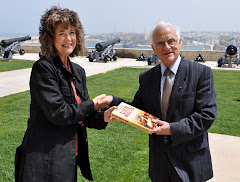
Former President of Malta Edward Fenech Adami was guest of honour at the launch of UXB Malta, hosted by Fondazzjoni Wirt Artna at the Saluting Battery in Valletta. He was presented with a copy of the book which tells how as an eight year old in 1942 his life was saved from an unexploded butterfly bomb by the RE Bomb Disposal Officer. Also attending were others who contributed personal stories to UXB Malta, as well as representatives of Malta’s military heritage organisations and George Cross Island Association.
Friday, 7 May 2010
70th Anniversary of RE Bomb Disposal Commemoration 11 May 2010
“I was always aware that I might be killed, but you had a job to do. You couldn’t allow yourself to be overcome by your feelings.” So says former Lt George Carroll, one of the oldest surviving bomb disposal officers of the London blitz, on Channel 4 documentary ‘Blitz Street’.
92 year old George Carroll will be guest of honour at a gathering to mark the 70th anniversary of Army bomb disposal on Tuesday 11 May, at the Royal Engineers (RE) Museum in Gillingham, Kent. He will be formally presented with a copy of ‘UXB Malta’ in memory of his service as one of the handful of men who dealt with 7300 unexploded bombs in just two years of World War 2, often under enemy fire.
George Carroll will meet and compare his wartime experiences with former officers whose careers span seven decades of bomb disposal. Joining them will be the families of those who served in the blitz on Malta.
At noon they will unite in remembering the many who have lost their lives in this hazardous occupation, and acknowledge the courage of those still dealing with disabilities resulting from their service. Losses were heaviest in the first five years. In 1940 the average life expectancy of bomb disposal officers was ten weeks. By the end of the war 490 officers and men had been killed and 209 injured.
The challenge they face has changed little since then: an enemy constantly developing new bombs designed to kill them. George Carroll still vividly remembers dealing with his first unexploded bomb, three weeks before he had any training. As the Germans introduced ever more complex fuzes, he learned as he went along – and survived – even when a Messerschmitt pilot strafed the ground with bullets while he was working on a 1000kg Hermann bomb.
Today’s bomb disposal personnel undergo extensive training and preparation before being deployed on active service. But in Iraq and Afghanistan they have to deal with the deadly unpredictability of Improvised Explosive Devices (IED, each one individually made in an attempt to outwit them.
Yet despite the years which divide them, it seems that bomb disposal men have at least one thing in common. When described as heroes, they all give a similar response: they were ‘just doing a job’.
92 year old George Carroll will be guest of honour at a gathering to mark the 70th anniversary of Army bomb disposal on Tuesday 11 May, at the Royal Engineers (RE) Museum in Gillingham, Kent. He will be formally presented with a copy of ‘UXB Malta’ in memory of his service as one of the handful of men who dealt with 7300 unexploded bombs in just two years of World War 2, often under enemy fire.
George Carroll will meet and compare his wartime experiences with former officers whose careers span seven decades of bomb disposal. Joining them will be the families of those who served in the blitz on Malta.
At noon they will unite in remembering the many who have lost their lives in this hazardous occupation, and acknowledge the courage of those still dealing with disabilities resulting from their service. Losses were heaviest in the first five years. In 1940 the average life expectancy of bomb disposal officers was ten weeks. By the end of the war 490 officers and men had been killed and 209 injured.
The challenge they face has changed little since then: an enemy constantly developing new bombs designed to kill them. George Carroll still vividly remembers dealing with his first unexploded bomb, three weeks before he had any training. As the Germans introduced ever more complex fuzes, he learned as he went along – and survived – even when a Messerschmitt pilot strafed the ground with bullets while he was working on a 1000kg Hermann bomb.
Today’s bomb disposal personnel undergo extensive training and preparation before being deployed on active service. But in Iraq and Afghanistan they have to deal with the deadly unpredictability of Improvised Explosive Devices (IED, each one individually made in an attempt to outwit them.
Yet despite the years which divide them, it seems that bomb disposal men have at least one thing in common. When described as heroes, they all give a similar response: they were ‘just doing a job’.
Subscribe to:
Posts (Atom)